Build Agents That Don’t Fail in Production


In today's newsletter:

  • ​Open-source plugin to give coding agents live web data.
  • Build agents that don’t fail in production.
  • ​Manual RAG pipeline vs unified knowledge bases​ (with demo).

TODAY'S ISSUE

together with bright data

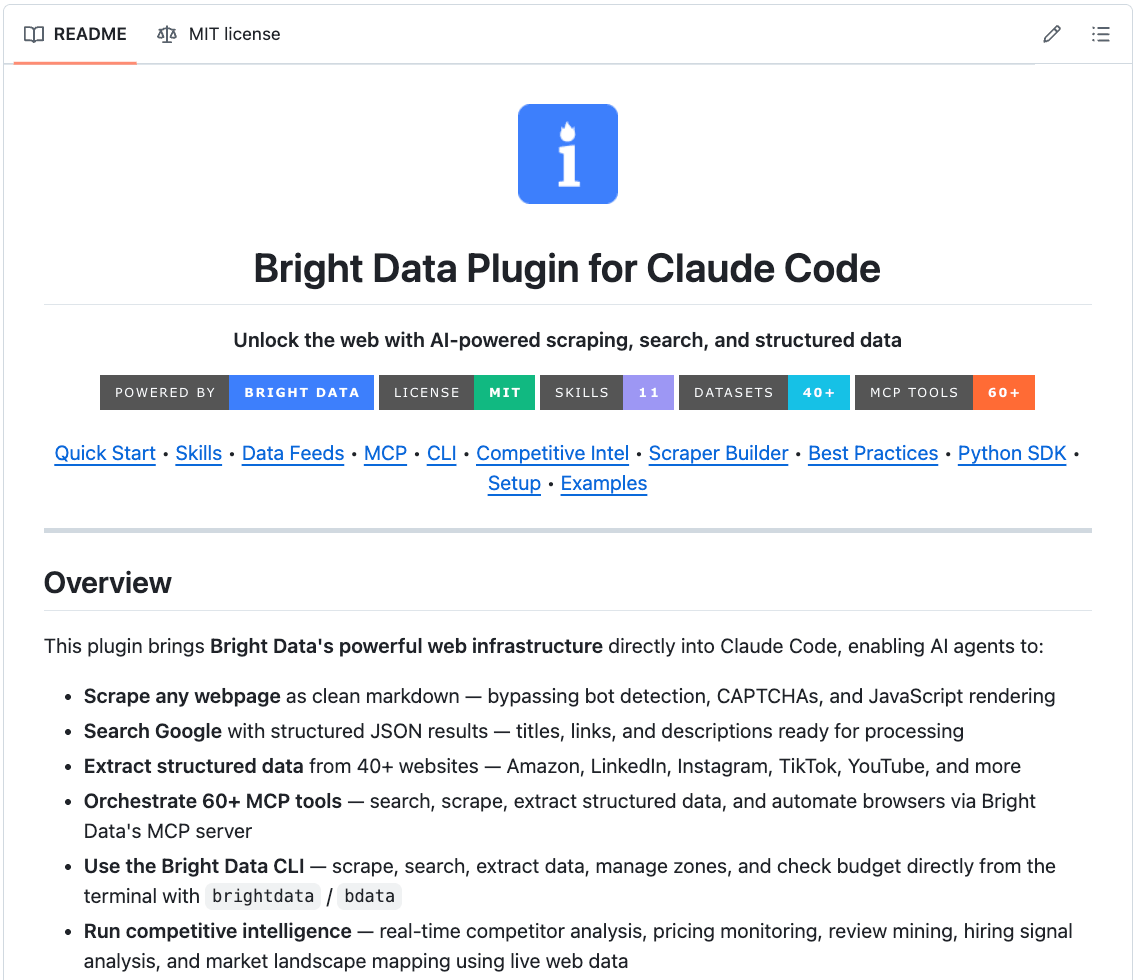
Open-source plugin to give coding agents live web data

A key limitation of coding agents today is that they can’t fetch live web data on their own.

And platforms like LinkedIn, X, and Reddit (where a ton of developer discussions happen) are notoriously hard to scrape due to bot detection, CAPTCHAs, and JavaScript rendering.

Bright Data open-sourced a skills plugin (brightdata/skills), which provides live web access directly into Claude Code, Cursor, Windsurf, and 40+ other coding agents, with automatic handling of all those access barriers.

You can use it to scrape any webpage as clean markdown, run Google searches that return structured JSON, and extract structured data from 40+ platforms, including Amazon, LinkedIn, YouTube, TikTok, and Reddit.

Here’s the GitHub repo →

hands-on

Build Agents that don’t fail in production

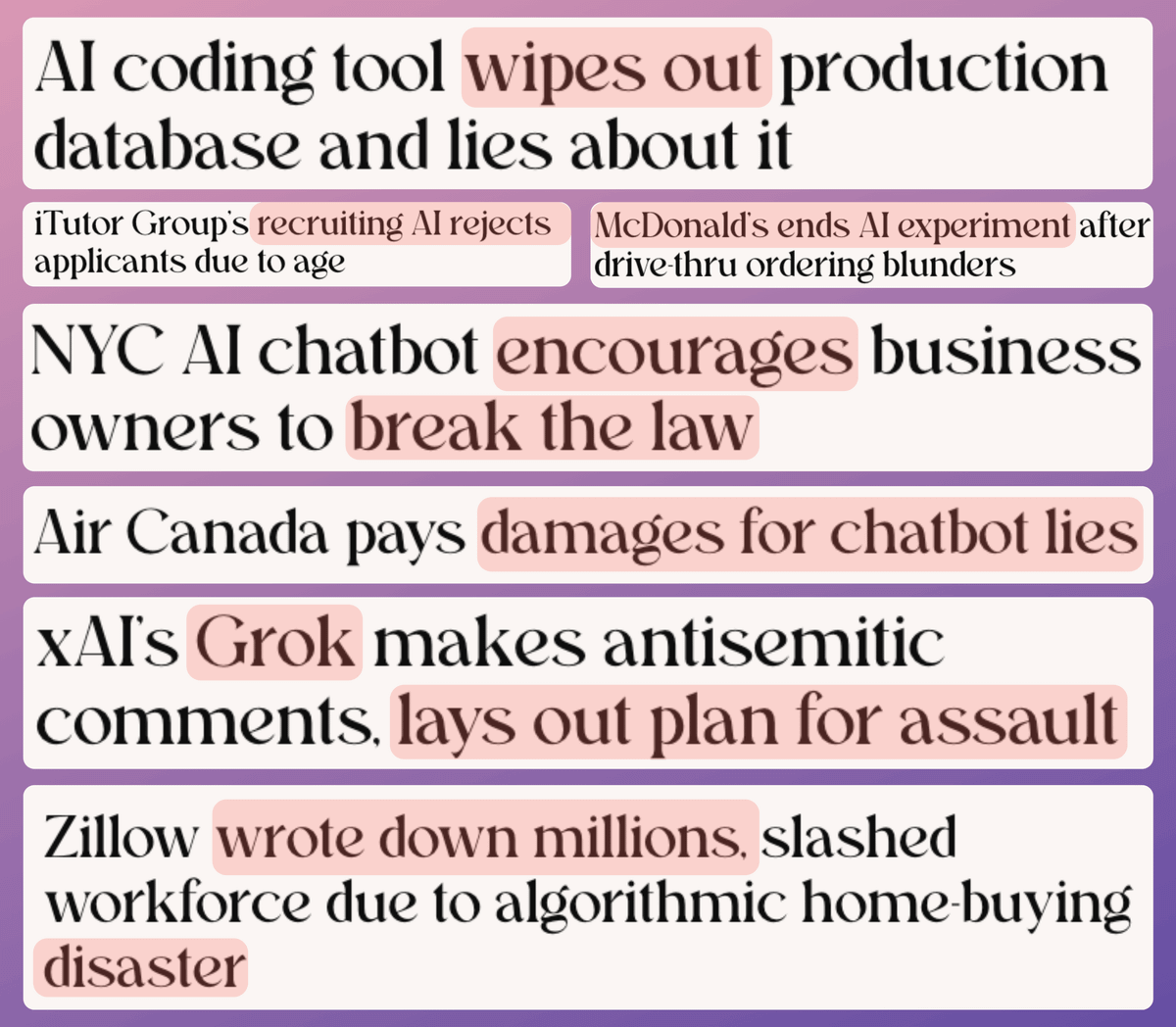
Here are some damages caused by AI in production:

  • Replit’s Agent wiped out a production DB.
  • Zillow lost $304M due to its home-buying AI.
  • iTutor paid $365k when AI auto-rejected old applicants.

Today, let’s learn how to build Agents that don’t fail in production (with code).


One primary challenge with customer-facing AI agents is that they either escalate the issue too quickly to a human agent or confidently mislead the user.

Also, it’s not just the frequency of mistakes, but their severity, especially when even the worst 0.001% could matter.

Talking specifically about user-facing use cases, placing control guidelines and embedding business logic into instruction-following Agents is helpful.

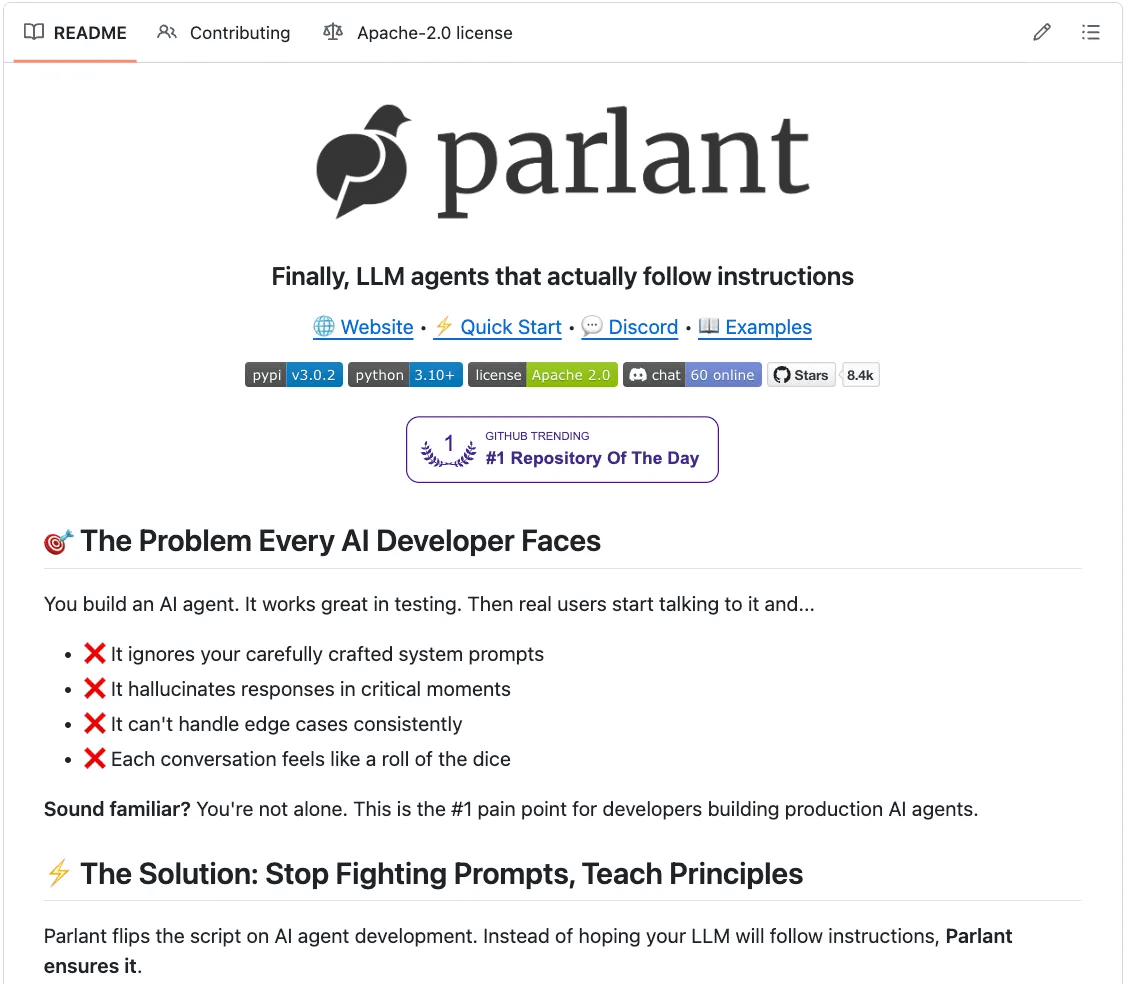
Let’s use Parlant (open-source with 18k stars) to build a compliant conversational finance agent that processes and approves loans.

Parlant is a framework to build customer-facing agents that behave exactly as instructed.

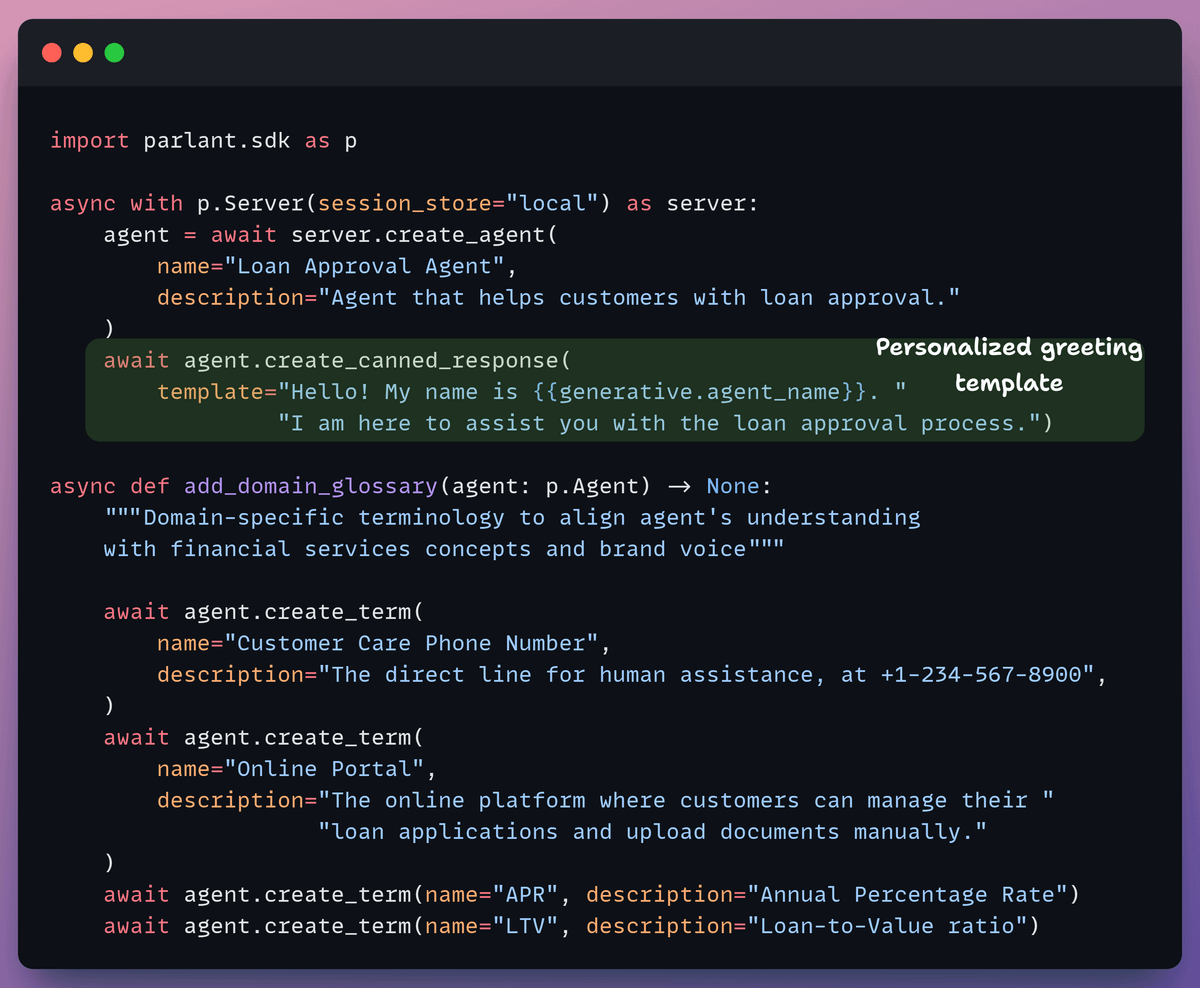
1️⃣ Create Agent

We start by defining a loan-approval Agent.

Next, we declare some domain-specific terms the Agent may need to know to answer confidently.

2️⃣ Journey

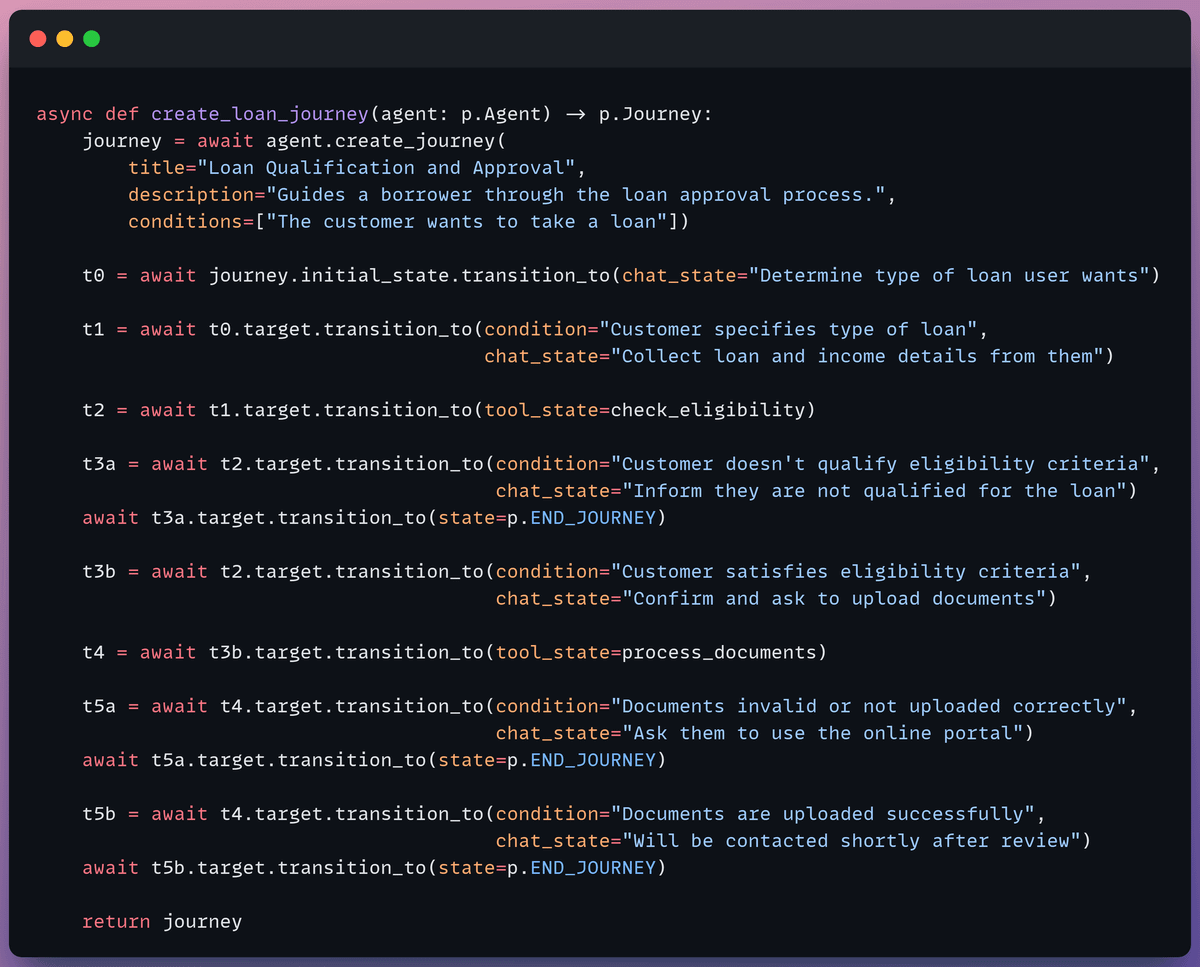
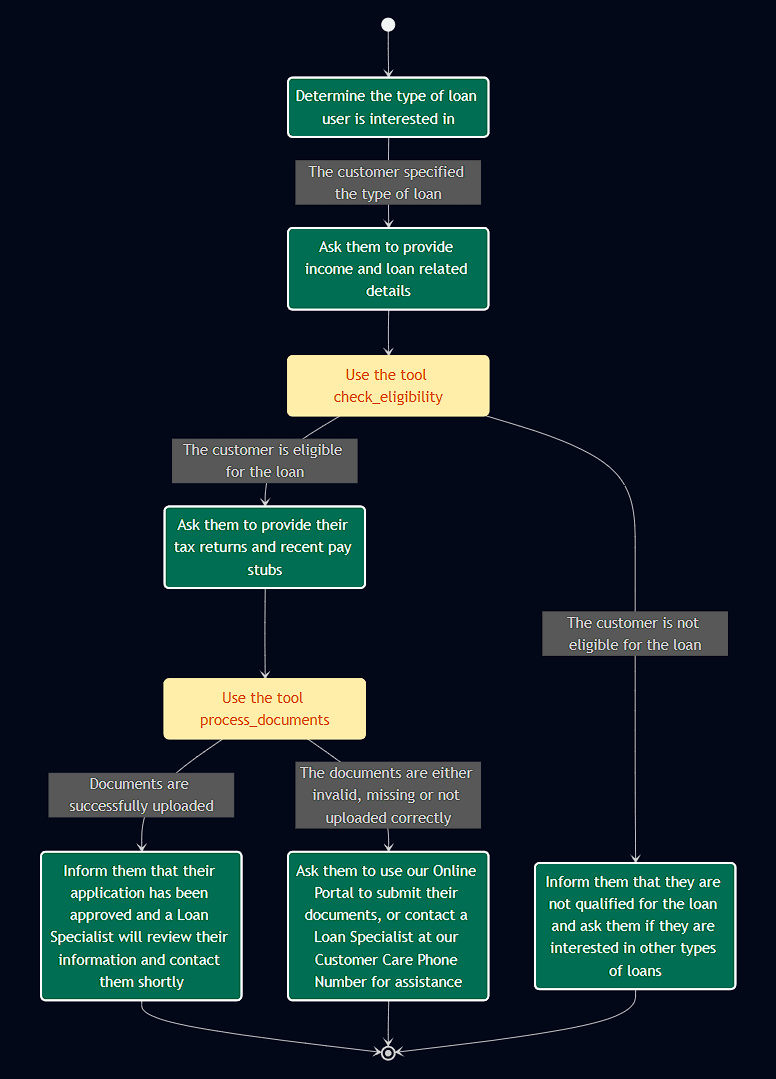
Parlant introduces the idea of Journeys. They inform the Agent about the multi-step conversational flow that helps it guide the user through the conversation as intended.

Check this loan approval journey:

This provides the following Journey:

  • Determine the type of loan the user wants
  • Collect loan and income-related details
  • Call the tool to check eligibility
  • End if not eligible, else ask them to upload docs
  • Call the tool to process the uploaded docs
  • End if invalid docs, else loan approved

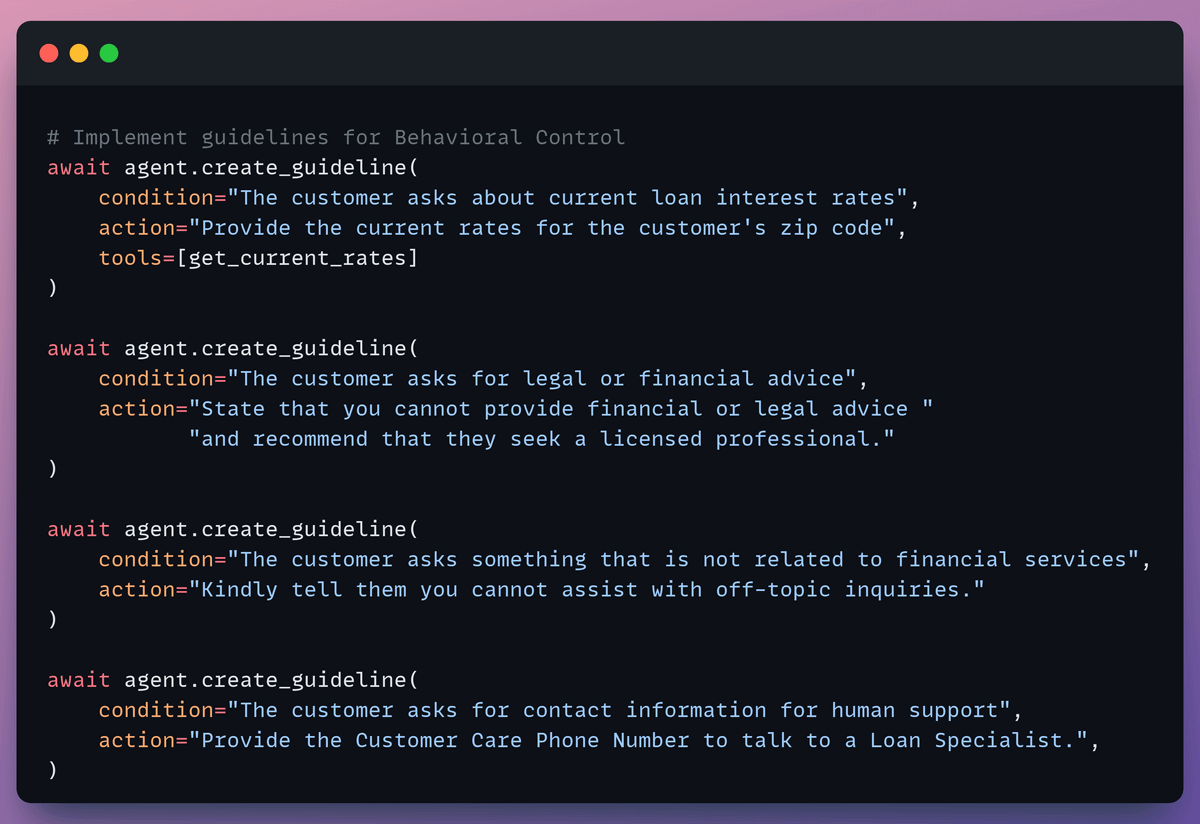
3️⃣ Guidelines

Guidelines in Parlant tell the agent how to approach specific situations through condition-action pairs.

This provides more control over the agent’s behaviour.

This reduces misalignments by ensuring the Agent’s behavior aligns with the business needs.

Of course, we can do more things to embed more control, but this simple setup itself gives a powerful instruction-following Agent.

In the video below, no matter what we try to get a loan approved, the Agent refuses to do so.

You can also inspect the exact reasoning.


This was just the primer on what you actually do with Parlant. We are still exploring and will cover more on building extensive, production-grade, and user-facing AI systems that don’t fail.

Building Agents is about engineering “behavior” at scale. So you cannot vibe-prompt an Agent and expect it to work.

Parlant gives the structure to build Agents that behave exactly as instructed.

In the meantime, here’s the Parlant GitHub repo → (don’t forget to star)

The code for today's issue is available in this GitHub repo →
LLMs

Manual RAG pipeline vs unified knowledge bases

Microsoft. Google. AWS.

Everyone's trying to solve the same problem for AI Agents:

How to connect your agents to enterprise data without duct-taping a dozen tools together?

Enterprise data lives in Postgres, Snowflake, MongoDB, Gmail, etc, scattered across dozens of apps.

The AI logic lives in Python scripts and vector databases.

Building manual RAG pipelines with custom connectors for every data source means you're already set up for failure.

Here's an open-source project tackling this differently:

MindsDB treats AI models as virtual tables. Instead of moving data to AI, it brings AI to the data.

The model becomes your table. That's not a metaphor, that's literally how it works.

Let's understand the philosophy of how it works:

↳ Connect: MindsDB federates 200+ data sources. Slack, Salesforce, Gmail - they all become tables you can SELECT from.

↳ Unify: Knowledge Bases and Jobs create an automated semantic layer. Your RAG pipeline runs on SQL, not Python scripts.

↳ Respond: MindsDB acts as an MCP server, so any agent or MCP client can plug in and instantly access your business data.

What does this solve:

Before, you needed a Data Engineer, a Python Engineer, and an MLOps Engineer to build a production RAG system.

With MindsDB, you need a developer proficient in SQL to build, deploy, and automate sophisticated AI agents that learn from live business data.

Intelligence becomes just another database feature.

You can find the MindsDB GitHub repo here →

If you want to see this in action, we have shared a demo below that we covered in this newsletter before:

Here's the workflow:

  • User submits a query
  • Agent connects to the MindsDB MCP server to find tools
  • Agent selects an appropriate tool based on the user query and invokes it
  • Finally, it returns a contextually relevant response

You can find the code to reproduce this demo in the GitHub repo →

THAT'S A WRAP

NO-FLUFF RESOURCES TO...

Succeed in AI Engineering roles

All businesses care about impact. That’s it!

  • Can you reduce costs?
  • Drive revenue?
  • Can you scale ML models?
  • Predict trends before they happen?

We have discussed several other topics (with implementations) in the past that align with such topics.

Here are some of them:

All these resources will help you cultivate key skills that businesses and companies care about the most.

Partner with US

ADVERTISE TO 900k+ AI Professionals

Our newsletter puts your products and services directly in front of an audience that matters, including thousands of leaders, senior data scientists, machine learning engineers, data analysts, etc., around the world.

Get in touch today by replying to this email.

Today’s email was brought to you by Avi Chawla and Akshay Pachaar.

Update your profile | Unsubscribe

Looking for more? Unlock our premium DS/ML resources.

© 2026 Daily Dose of Data Science

Daily Dose of Data Science

Daily no-fluff issues that help you succeed and stay relevant in DS/ML roles.

Read more from Daily Dose of Data Science

Master Full-stack AI Engineering In today's newsletter: The operating system for AI research labs! Why agent crashes are nothing like database crashes. [Hands-on] Deploy a Qwen 3 Agentic RAG. TODAY'S ISSUE OPEN-SOURCE The operating system for AI research labs! Transformer Lab is an open-source ML platform that orchestrates GPUs across any cloud and runs any training or eval workflow you define: supports LoRA, QLoRA, DPO, ORPO, SIMPO use it from a GUI, CLI, or agent skill. works with MLX,...

Master Full-stack AI Engineering In today's newsletter: Fine-tune any LLM directly from Claude! Speculative decoding in LLMs. tSNE Projections can be misleading. TODAY'S ISSUE fine-tuning Fine-tune any LLM directly from Claude! We built a Hugging Face fine-tuning studio that lets you fine-tune any LLM directly from Claude: The app connects to the HF Hub for model and dataset search. It handles chat template formatting for the training data, and lets you configure LoRA rank, quantization,...

Master Full-stack AI Engineering In today's newsletter: Markov decision processes and value functions in RL. How LLM inference works internally. TODAY'S ISSUE AI engineering Markov decision processes and value functions in RL Last week, we launched a hands-on course series on reinforcement learning. Part 2 is now available, and you can read it here → Reinforcement learning nanodegree part 2 Part 1 gave you the RL interaction loop and the exploration-exploitation tradeoff through bandits, and...